
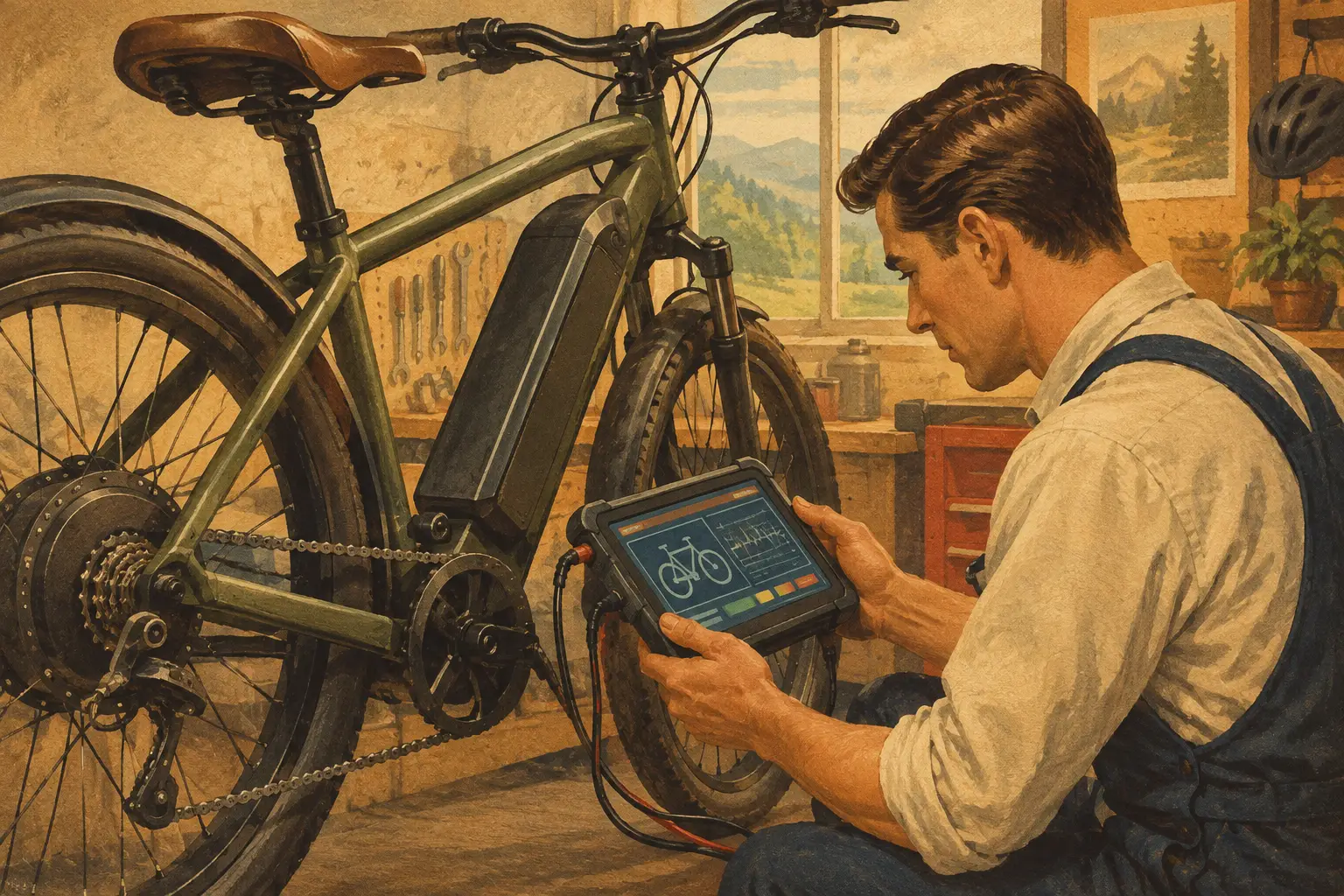
A warning code, intermittent power cut or sudden loss of assistance is not a diagnosis. Proper electric bike diagnostics trace the fault through the whole system: battery, charger, wiring, display, controller, motor and the mechanical load the motor is being asked to overcome. Clearing a message or replacing the most obvious part may get an e-bike moving again. It does not prove it is safe, reliable or ready for a long ride.
For riders who use an e-bike for commuting, touring, off-road riding or adaptive cycling, that distinction matters. A fault that appears only under climbing load, in wet weather or after an hour of riding can leave you stranded a long way from home. More seriously, damaged battery enclosures, overheated connections and modified wiring require an engineering-led assessment, not guesswork.
What proper electric bike diagnostics involve
An e-bike is a powered vehicle with a bicycle attached to it, not simply a conventional bike with a motor bolted on. The electrical system works only when several components agree that conditions are safe: the battery must supply stable voltage, the controller must receive credible signals, sensors must report correctly, and the motor must operate within its temperature and current limits.
A sound diagnostic process begins with the rider’s account. When does the problem occur? Is assistance lost under load, after charging, over rough ground or only in a particular support mode? Has the bike been crashed, carried on a rear rack, stored in a cold shed or fitted with non-standard accessories? These details often narrow the investigation faster than a fault-code list.
The next stage is a visual and mechanical inspection. We look for damaged cable routes, water ingress, strained connectors, corrosion, loose battery latches, impact damage to the motor area and evidence of previous repairs. Wiring can look acceptable at rest yet pull apart when the handlebars turn or the suspension moves through its travel. On full-suspension bikes, cable movement around pivot points deserves particular attention.
Only then is it sensible to interrogate the electronic system and measure what it is doing. Diagnostic software and manufacturer tools can reveal stored errors, sensor readings, battery status, firmware information and component communication. They are useful, but they are not a substitute for measurement or judgement. A code indicates what the system has detected, not necessarily why it detected it.
Fault codes are a starting point, not a verdict
A communication error may be caused by a failed display, a damaged harness, moisture in a connector, a weak battery supply or a controller fault. A speed-sensor error can originate at the sensor itself, its cable, the spoke magnet or rotor magnet, the mounting position, or physical damage where the wire enters the chainstay.
This is why replacing components from a code alone is expensive and often ineffective. It can also introduce new compatibility and software issues. E-bike systems are designed as matched assemblies, and substitutions need to be assessed for voltage, connector type, current capacity, firmware compatibility and legal road-use requirements.
Intermittent faults are especially revealing. If the display cuts out when the front wheel is turned, the loom may be fractured internally near the headset. If assistance drops during a steep climb but returns after a rest, the battery may be sagging under load, the connection may have high resistance, or the motor and controller may be reaching a protection threshold. The right answer depends on evidence from a controlled test, not the symptom alone.
Battery and charging assessment
The battery is commonly blamed because it is the most visible electrical component. Sometimes it is the cause. Often it is not.
A meaningful battery assessment considers more than the percentage shown on the display. It includes physical condition, latch security, terminal wear, charging behaviour, voltage stability and performance under demand. A battery can appear to charge normally yet suffer a significant voltage drop when climbing, accelerating or using high assistance. The battery management system may then limit output or shut down to protect the cells.
Age is only one factor. Storage temperature, charging habits, mileage, repeated deep discharge, water ingress and long periods unused all affect battery health. A battery with damaged casing, swelling, abnormal heat, burnt smell or compromised terminals should not be charged or ridden until it has been professionally assessed. Do not open a lithium-ion battery pack at home. The risks include short circuit, fire and exposure to hazardous materials.
The charger also needs checking. An incorrect, damaged or poor-quality replacement charger can cause charging faults and may place unnecessary stress on the battery. The correct output specification and connector are not optional details.
Motor, controller and sensor faults
Motor faults are not always motor failures. Before condemning a hub motor or mid-drive unit, the workshop should establish whether it is receiving the correct power and control signals, and whether the drivetrain is creating excessive resistance.
On a mid-drive e-bike, worn chains, hooked sprockets, stiff links, a contaminated derailleur clutch or poor shifting can make the bike feel weak and harsh. The motor is then working against avoidable losses. High torque accelerates drivetrain wear, so a neglected transmission can affect both ride quality and perceived electrical performance.
Cadence, torque and speed sensors must also work as a coherent set. A torque sensor that reads inaccurately may give jerky assistance, delayed pick-up or unexpectedly forceful support. A speed signal that disappears can stop assistance altogether. Brake cut-off switches, where fitted, can likewise hold the system in a no-drive state if a lever sensor is misaligned or a cable is damaged.
The controller is the decision-maker between battery and motor. It manages current, interprets sensor inputs and protects the system when it detects a fault. Because controllers are expensive and system-specific, replacement should follow testing of supply voltage, earth paths, connectors and peripheral components. Otherwise, a new controller may be damaged by the original fault.
Mechanical condition still matters
Electrical diagnosis should not ignore the bicycle underneath. Binding brakes, dry hub bearings, tyre damage, a dragging mudguard, seized suspension pivots or a misaligned derailleur all reduce range and can mimic an assistance problem. A rider may describe the bike as lacking power when the actual issue is rolling resistance or transmission loss.
Brake inspection is particularly important on heavier e-bikes. A lightly rubbing disc may be barely noticeable on a workstand but become significant during a journey, especially after the rotor heats up. Wheel trueness, spoke tension and tyre condition also matter more because e-bike weight and torque increase the load carried by wheels and tyres.
For conversion kits, the standard is higher again. Cable routing, battery mounting, torque arms, dropout condition, brake performance and frame suitability must all be assessed as a complete installation. A conversion that functions electrically may still be unsafe if the structure is not managing motor torque properly.
What to bring to an e-bike diagnostic appointment
Bring the complete bike, its battery, charger, display or key, and any relevant keys or security adapters. If the problem occurs with a particular pannier, lighting system or accessory connected, bring that too. A short note of the fault behaviour is genuinely helpful: the distance ridden before it occurs, the weather, assistance mode, battery level, terrain and any message displayed.
Avoid repeatedly charging, resetting or riding a bike that has a hot battery, damaged wiring, a burning smell, water inside electrical components or unexplained shutdowns. Photograph any warning message if it disappears before the appointment. Do not attempt improvised connector repairs with household tape, unsuitable crimp terminals or unsealed joins. Those repairs can conceal the evidence needed to find the root cause.
At Ewhurst Bikes, e-bike work is approached as a system assessment rather than a parts-changing exercise. The aim is to identify the failure mechanism, agree the repair before work proceeds, and return a machine that is dependable for the riding it actually has to do.
When repair is sensible and when it is not
Repair is often the best value where the fault is a harness, connector, sensor, battery mount, drivetrain issue or a serviceable mechanical cause. It preserves a good bike and avoids replacing expensive assemblies unnecessarily. A refurbishment can also make strong sense for a well-built frame with an ageing battery or neglected transmission.
There are limits. Some proprietary systems have restricted diagnostic access, discontinued parts or battery packs that cannot be safely rebuilt to a satisfactory standard. Crash damage around a motor mount, battery rail or frame joint may need structural inspection before any electrical repair is worthwhile. In these cases, an honest assessment is more useful than a cheap-looking fix that shifts the risk to the rider.
If your e-bike has become unpredictable, treat that behaviour as useful evidence rather than an irritation to be reset away. Bring the complete system and the story of how it fails. A careful diagnosis can turn an uncertain machine back into equipment you can trust on the school run, the daily commute or the next long ride.







Leave A Comment