
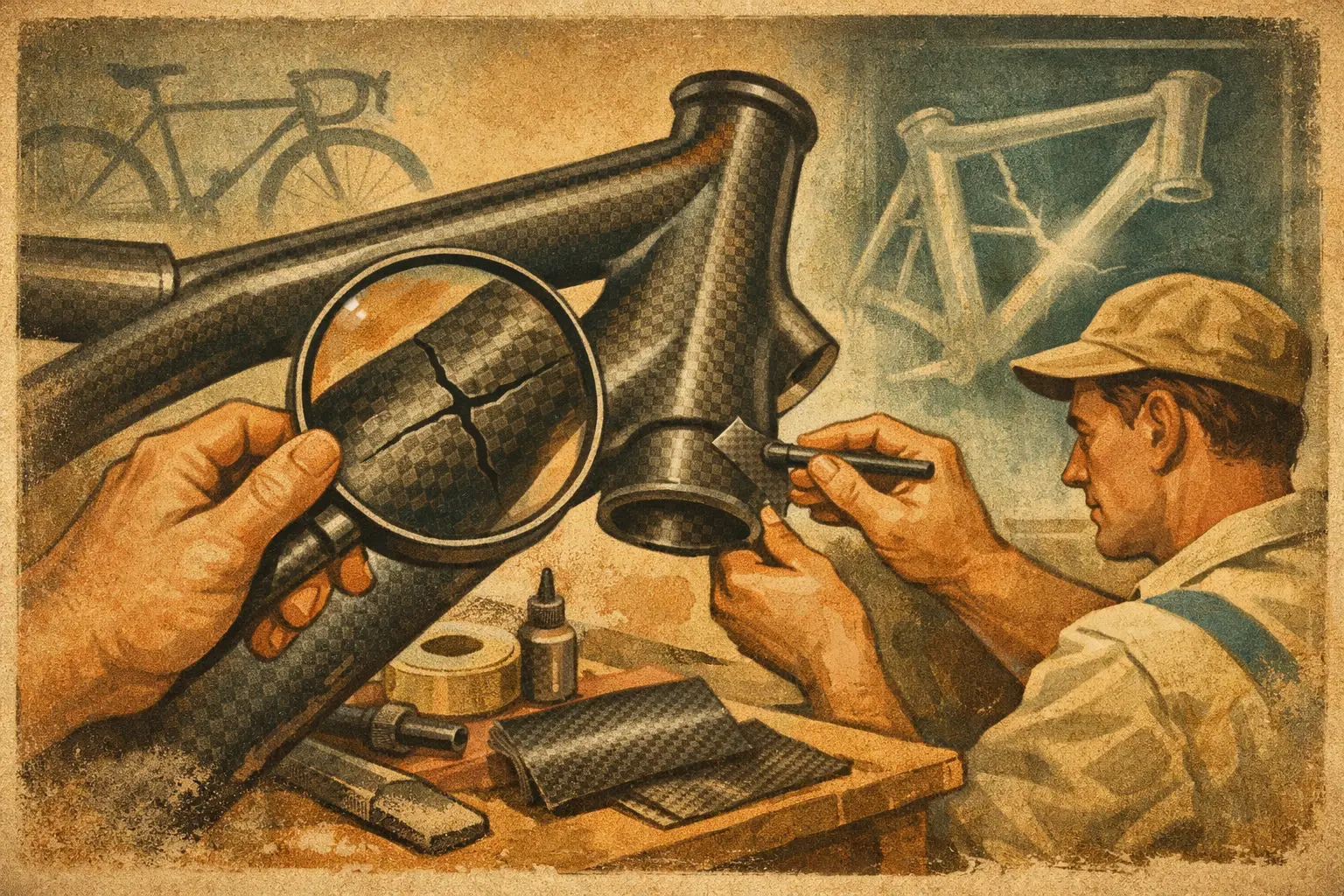
A carbon frame can look almost untouched after an impact, yet have serious damage beneath the paint. Equally, a dramatic-looking chip in lacquer may be no more than cosmetic. That is why the useful question is not simply, can cracked carbon be repaired, but whether the damage can be correctly diagnosed and rebuilt into a safe, durable structure for the way you ride.
For a lightly loaded bottle-cage area, the answer may be straightforward. For a fork steerer, handlebar, stem, suspension linkage or a heavily stressed section of a race frame, the decision requires far more caution. Carbon is not a metal tube with a visible crack line. It is a carefully arranged composite structure, and its strength depends on fibre direction, laminate thickness, resin condition and the way loads travel through the part.
Can cracked carbon be repaired safely?
Yes, many cracked carbon bicycle components can be repaired safely, provided the damage is accessible, the original structure can be understood, and the repair is designed around the loads that part actually sees. A proper repair does not mean filling a crack with resin, sanding it smooth and applying black paint. It means removing failed material, rebuilding the laminate with suitable fibre orientations, consolidating and curing it correctly, then checking the finished component for soundness and alignment.
There are limits. Carbon repair is not automatically the right answer simply because a damaged part is expensive to replace. Some damage is too extensive, too close to a critical joint, or too poorly defined to justify returning the component to service. An honest assessment should be willing to say so.
What makes carbon damage repairable?
Damage to a frame tube away from highly concentrated load paths is often repairable. A crushed top tube from a roof-rack incident, a crack from handlebar contact, transport damage, or local impact damage caused by a stone can frequently be rebuilt successfully. The repair area may need to be larger than the visible mark, because damage often extends beyond the point where the surface has split.
A carbon rim can also sometimes be repaired, but the decision depends on rim construction, brake track condition, spoke-bed damage, tyre pressures and intended use. A lightly used road wheel is not assessed to the same standard as a loaded gravel wheel or an enduro mountain bike wheel repeatedly subjected to hard impacts.
The best candidates are parts with localised damage, known history and sufficient sound material around the affected area. If the cause is known, it can be addressed. For example, a chainstay damaged by tyre rub, a frame worn through by an incorrectly routed hose, or a tube crushed by a clamp needs more than a structural rebuild. The clearance, routing or clamping method must also be corrected, otherwise the same failure will return.
The areas that need greater caution
Some components demand a much higher threshold for repair or replacement. Fork steerers and crowns, handlebars, stems, seatposts, crank arms and suspension components are all safety-critical. Their loading is complex, their failure consequences are immediate, and the original construction may be difficult to establish without destructive investigation.
A crack at a head tube, bottom bracket, dropout, pivot mount or suspension shock mount is not automatically beyond repair. However, these areas experience concentrated and repeated loads. A repair must restore not only material strength, but also stiffness, bearing alignment and load transfer into the surrounding laminate. This is engineering work, not a cosmetic exercise.
Unknown crash history is another warning sign. If a bike has been run over, involved in a high-speed collision, or suffered multiple impacts, visible damage may represent only part of the problem. A replacement part can be the more sensible choice, particularly where a new component is available and traceable.
Diagnosis comes before any carbon repair
Paint can hide cracks, and surface cracks can be misleading. The assessment starts with the rider’s account: what happened, where the bike was struck, whether it was ridden afterwards, and whether handling, noise or alignment changed. That context matters. A crack appearing after a low-speed fall is assessed differently from one that developed gradually around a heavily loaded luggage mount.
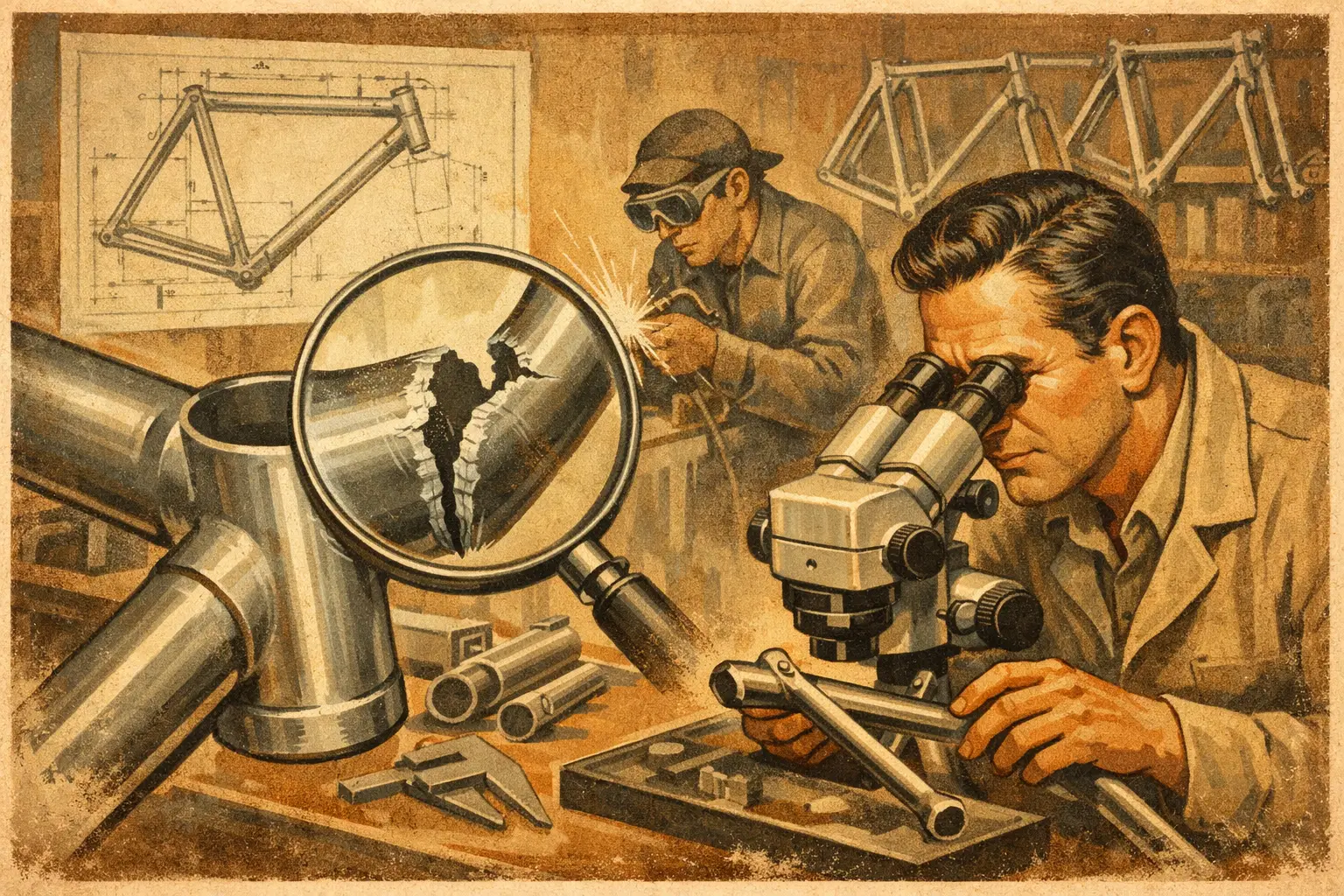
The component is then cleaned and inspected under good light. Areas of concern may need paint, lacquer, decals or filler removed to expose the actual laminate. A tap test can help identify changes in stiffness or possible delamination, but it is only one indication and should never be treated as a complete diagnosis. Close visual inspection, measurement and an understanding of the component’s structure remain essential.
The workshop should also look for the root cause. Was the frame clamped incorrectly? Did a headset bearing seize and overload the head tube? Has a rear axle been loose, allowing movement at a dropout? Is a suspension pivot worn, or has a bearing seat distorted? Repairing the carbon without correcting the fault that caused it is short-term thinking.
How a structural carbon repair is carried out
A sound repair begins by removing all compromised fibres and resin. Leaving fractured material beneath a patch simply traps the original failure in place. The damaged zone is carefully tapered into the healthy laminate so that new material can overlap and transfer loads progressively, rather than ending at a sharp stress concentration.
The replacement laminate is then designed around the component and the damage. Carbon fibres are directional. Fibres running along a tube resist different loads from fibres wrapped around it or laid on a bias. Rebuilding a structure means restoring the right combination of orientations, overlap and thickness, while avoiding an unnecessarily heavy, stiff local patch that creates a new stress riser at its edge.
The repair must be prepared on a clean, stable substrate, consolidated properly and cured under controlled conditions. Depending on the part and process, this can involve vacuum consolidation, carefully selected resin systems and controlled heat. Once cured, the area is finished, inspected and checked for alignment where relevant. A frame repair may also require derailleur-hanger, dropout, brake-mount and wheel alignment checks before it is returned to service.
The final appearance matters less than the structural work underneath. A flawless gloss finish can conceal weak workmanship; a visible repair, honestly finished, may be the better engineering outcome. If cosmetic refinishing is requested, it should follow the structural inspection, not replace it.
Why a resin-filled crack is not a repair
Resin binds fibres together, but it is the fibre architecture that gives a carbon component much of its strength and stiffness. Injecting resin into a crack may improve the appearance temporarily, yet it does not restore broken fibres or rebuild a crushed laminate. It can also make later diagnosis harder by obscuring the failure boundary.
The same applies to simply wrapping a damaged tube with a generic carbon sleeve. Without knowing the condition below it, the load path, fibre direction and required extent of reinforcement, a patch can produce a component that looks reassuring but has not been properly engineered.
This distinction matters most to riders who use their bikes hard. A loaded touring bike, gravel racer, mountain bike or high-mileage road machine sees fatigue cycles that reveal weak repairs quickly. The goal is not merely to get the bike rolling this weekend. It is to return it to dependable service for the miles ahead.
When replacement is the better option
Replacement is normally the safer route when the damage is widespread, inaccessible or close to a critical interface that cannot be confidently rebuilt and verified. It may also be preferable when a carbon fork or cockpit component has been heavily crushed, when internal damage cannot be bounded, or when the original part has a history of repeated failures.
Economics matter too, but they should be considered properly. A repair can offer excellent value when it saves a high-quality frame, a discontinued model with a hard-won fit, or a custom machine that would be difficult to replace. Conversely, spending heavily on a repair to a basic component that has a readily available replacement may make little sense. The right decision balances safety, service life, performance, cost and the bike’s real value to its rider.
What to do when you find a crack
Do not keep riding a suspected structural crack to see whether it gets worse. Stop using the bike, take clear photographs before cleaning the area, and make a note of the incident or symptoms that led you to find it. Avoid pressing, flexing or drilling around the damaged section, and do not apply glue, tape or filler before inspection.
If the bike was involved in a crash, inspect the complete system rather than focusing only on the most obvious mark. Wheels, handlebars, stem, fork, frame, seatpost, pedals and drivetrain can all sustain consequential damage. A carbon frame may be sound while a bent hanger, damaged rim or compromised handlebar is the real immediate risk.
At Ewhurst Bikes, carbon assessment is approached as a failure-analysis and structural-repair job, with the aim of fixing the cause as well as the damaged laminate. Bring the bike’s history and your intended use into the conversation. A safe answer for a fair-weather commuter may not be the right answer for a rider preparing for an alpine descent, a winter gravel event or a fully loaded expedition.
A cracked carbon part deserves a measured decision, not panic and not wishful thinking. With competent diagnosis, many valuable bicycles can return to safe, long service. Where that confidence cannot be established, choosing replacement is not defeat – it is good engineering and good riding judgement.



Leave A Comment