
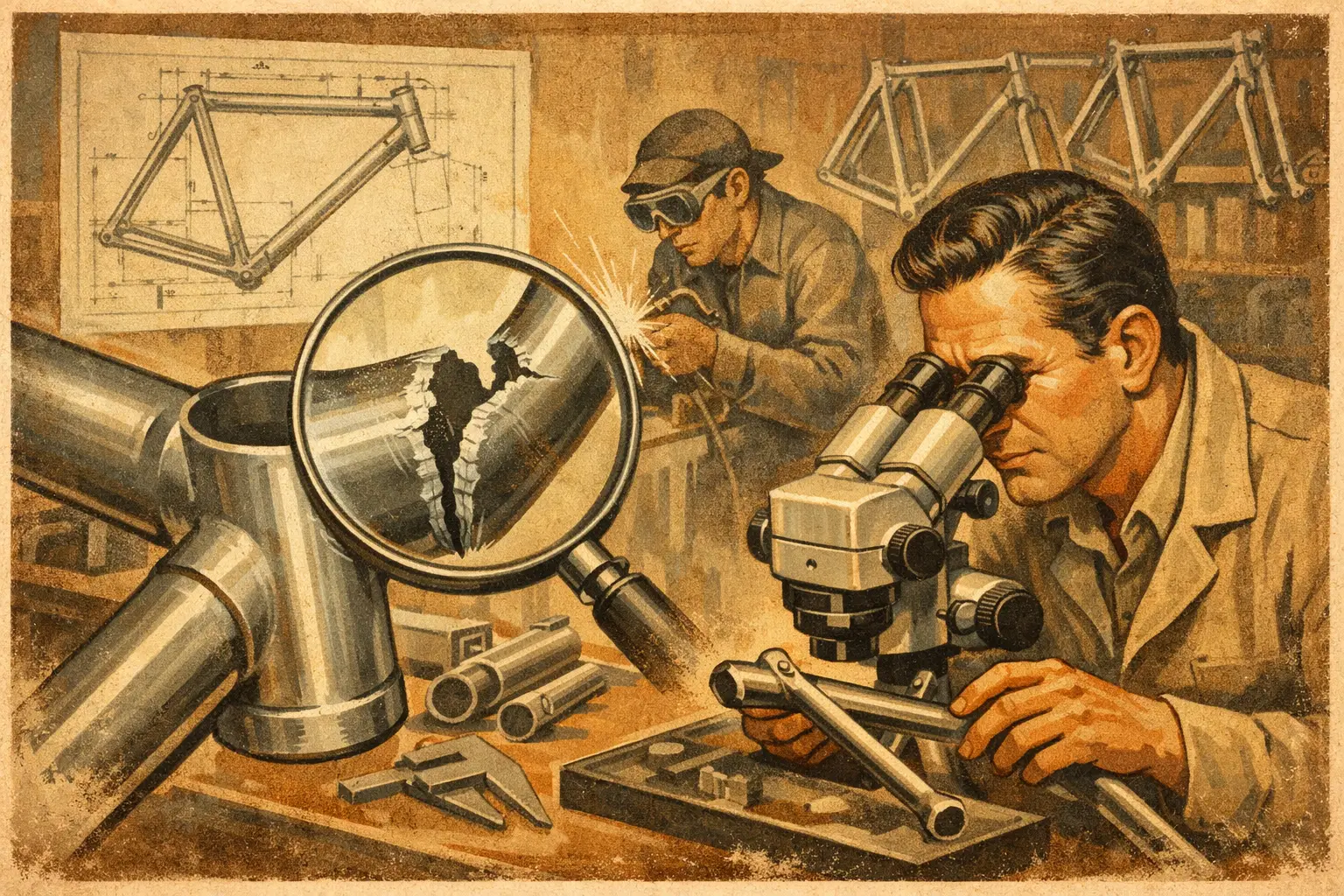
A crack beside a titanium weld is not a cosmetic fault, and it is rarely the whole story. For a rider who depends on a bike for long road miles, loaded touring, rough gravel or racing, expert titanium frame failure analysis and repair starts by establishing why that area was overloaded, not by simply adding weld metal over the visible split.
Titanium has earned its reputation for corrosion resistance, ride quality and exceptional service life. It is not, however, indestructible. A well-designed titanium frame can cover decades of hard riding; a poorly supported tube junction, damaged dropout, misaligned frame or repeatedly stressed accessory mount can still fatigue. The difference between a lasting repair and a repeat failure lies in the diagnosis.
Why titanium frames fail
Most titanium frame cracks are fatigue failures. A small area experiences repeated stress cycles until a microscopic defect becomes a visible crack. The final fracture may appear to happen suddenly, perhaps after a pothole or a loaded climb, but the process often began much earlier.
Weld-adjacent cracking is common because a tube junction changes stiffness and geometry in a short distance. Heat from the original weld also affects the surrounding material. That does not automatically mean the original weld was poor. A frame may have a sound weld yet be working beyond the fatigue margin created by its tube choice, joint design, rider load, luggage arrangement, wheel tracking or intended use.
The location tells a useful part of the story. A crack at a chainstay bridge can point to tyre clearance, mud build-up, a stiffened local feature or a load path altered by a rack. A seat tube or top tube crack close to a cluster may indicate flex concentrated around a restrictive joint. A dropout failure needs the axle interface, derailleur hanger, wheel dish, disc brake load and alignment checked together. On full-suspension and adaptive machines, bearing play and linkage alignment can transfer forces into areas never intended to carry them.
Titanium alloy matters too. Bicycle frames are commonly made from 3Al/2.5V tubing, while higher-strength 6Al/4V may be used for machined parts and specific components. These materials do not behave identically under forming, welding and cyclic loading. Treating every titanium frame as the same metal is an easy way to make poor decisions.
Expert titanium frame failure analysis before repair
The frame first needs to be stripped, cleaned and inspected without decals, dirt, cable rub or paint disguising the evidence. The visible crack is recorded, but so are dents, abrasion, tube ovalisation, corrosion around inserts, previous repairs and signs that a component has been moving where it should not.
At Ewhurst Bikes, the practical question is always: what changed the load path? A repair can be beautifully welded and still fail again if the cause remains in service. That is why inspection includes the whole bicycle where appropriate, not just the damaged tube.
Geometry, alignment and component checks
Frame alignment is central to a meaningful diagnosis. A rear triangle that has been knocked out of track can apply a constant bending load through stays and dropouts. A misaligned derailleur hanger can be both a shifting problem and evidence of impact. Fork alignment, wheel dish, axle seating, brake mounts and bearing interfaces may all reveal whether the frame has been carrying an unintended stress.
The rider’s set-up also matters. An oversized seatpost forced into a marginal tube, a seized post, an aggressively long exposed post, a heavy bikepacking load on light mounts or a powerful e-bike conversion can each create loads outside the assumptions behind an original frame. None of these automatically rules out repair. They do determine whether reinforcement, redesign or a change of equipment is required.
Establishing whether repair is sensible
Not every titanium frame should be repaired, even though many can be. A local fatigue crack in accessible, sound tubing is often a strong candidate. A damaged rack eyelet, bottle boss, dropout, bridge or cable guide may be repaired or remade with excellent long-term results.
The decision becomes less straightforward where there is extensive thinning, multiple cracks, severe crushing, contamination, a compromised head tube area or evidence of repeated failures across several joints. There is also a performance trade-off. Adding material can increase local strength, but unnecessary reinforcement can create a new stiffness transition beside the repair. Good engineering is not about making one spot as heavy as possible. It is about creating a controlled, durable route for the forces through the structure.
What a proper titanium repair involves
Titanium welding demands cleanliness, fit-up and inert-gas shielding that ordinary steel repairs do not. At welding temperature, titanium readily absorbs oxygen and other atmospheric gases. Contamination can leave a brittle, discoloured weld area with poor fatigue performance. The work must therefore be prepared and protected correctly, inside and outside the tube where the repair geometry requires it.
The cracked material is not simply joined at its edges. The damaged area is opened out and assessed so the full crack extent is removed. The tube is then repaired with an appropriate process, filler and joint preparation. Depending on the failure mechanism, this may involve a local sleeve, a shaped reinforcement, a replacement section or a revised mounting detail rather than a basic crack closure.
After welding, alignment is checked again. Brake and axle interfaces must remain accurate, and the repaired area must be finished without removing material that the repair relies upon. Cosmetic refinishing comes last. On a bare titanium frame, a tidy finish is desirable, but structural quality, alignment and freedom from contaminants are the priority.
Repairing the cause, not just the crack
A useful repair recommendation should describe what failed, why it likely failed and what will change afterwards. If a chainstay crack was driven by an overloaded rack mount, fitting a stronger patch without addressing the rack arrangement is not a complete job. If a seat cluster is too rigid for the exposed seatpost and riding load, the reinforcement must be designed to spread stress rather than merely lock the joint harder.
This is particularly relevant for endurance and expedition bikes. Long-distance riders often modify proven frames with larger tyres, extra bottles, dynamo wiring, luggage systems and wider gearing. Those changes can be entirely sensible, but their combined effect should be assessed. A bicycle is a structure, not a collection of isolated upgrades.
E-bike projects need the same discipline. Motor torque, battery mass, braking forces and altered usage can expose weaknesses in dropouts, mounts and stays. A frame that is satisfactory as an unassisted commuter may need a different solution once it is asked to deliver high torque on steep, rough routes every day.
What riders should do after finding a crack
Stop riding the bike until it has been assessed. Continuing to ride can turn a local, repairable fatigue crack into a larger failure involving adjacent tubes or a critical junction. Avoid attempting a home repair with adhesive, clamps or a drilled stop-hole. Those measures can obscure the evidence and complicate the eventual engineering work.
Bring the complete bicycle where possible, along with any relevant history: when the crack was first noticed, recent impacts, luggage use, changes of wheel, tyre or seatpost, e-bike equipment, previous repairs and the sort of riding the bike actually does. Clear photographs are helpful for an initial discussion, but they do not replace inspection of the frame and its interfaces.
A good repair should return more than appearance. It should give you a clear account of the fault, confidence in the structural work and practical advice on how to use the bike without recreating the same problem. For a titanium frame worth keeping, that is the value of engineering-led repair: preserve the ride you know, while making the next thousand miles less uncertain.
If your frame has cracked, been damaged in a crash or started showing unexplained movement around a joint, arrange an appointment before the fault grows. The most useful first step is a proper assessment with the bike’s real workload in view.




Leave A Comment