
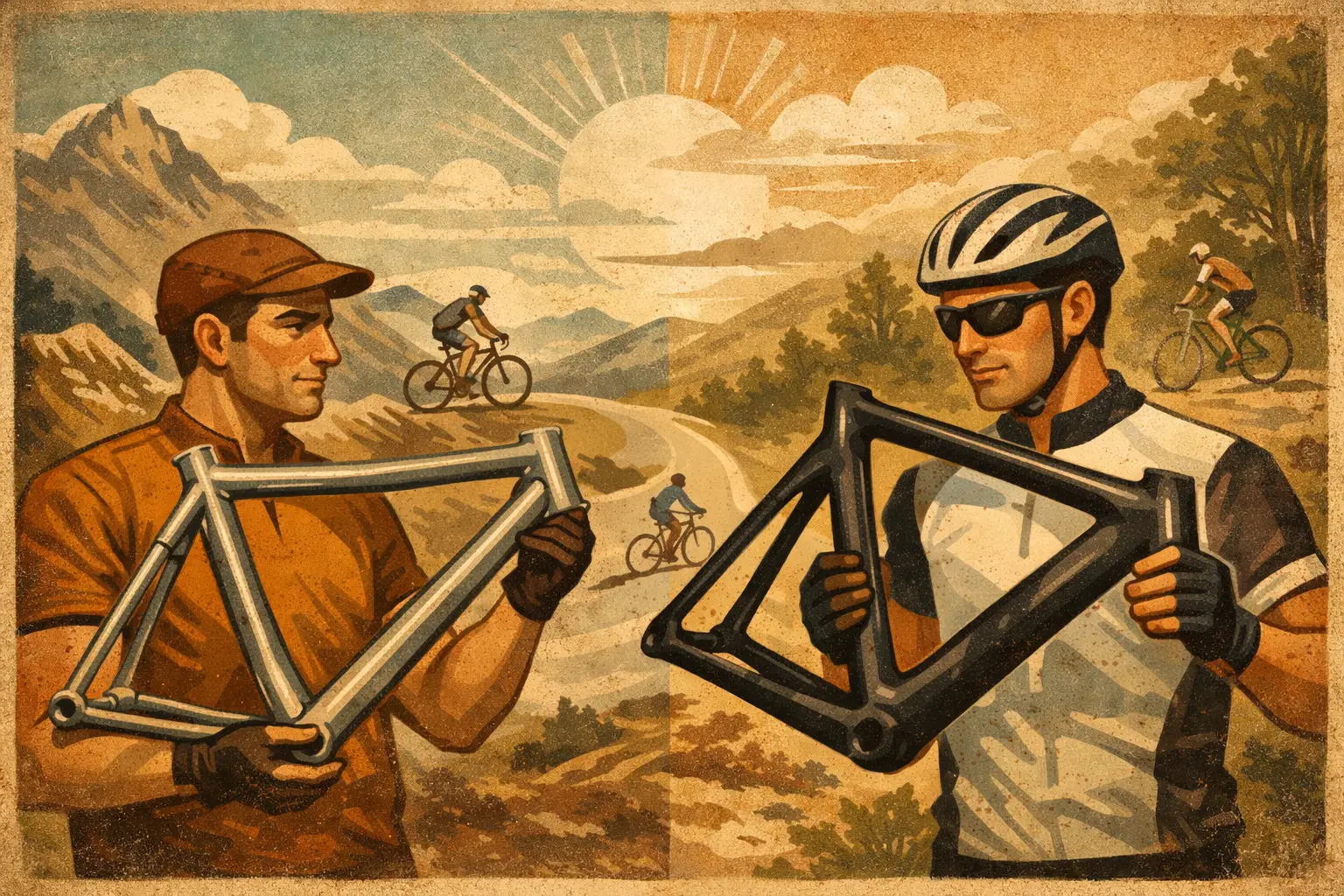
A frame choice becomes far more serious when your bike is expected to carry you through winter miles, rough lanes, loaded touring, long gravel events and years of hard use. The discussion around titanium versus carbon frames is often reduced to weight and ride feel, but those are only part of the engineering picture. Material behaviour, fatigue life, impact tolerance, repair options, component standards and the quality of the actual frame design all matter.
For some riders, a well-designed carbon frame is the fastest route to a light, precise race bike. For others, titanium is the more sensible long-term structure: tough, corrosion-resistant and capable of being repaired properly when damage occurs. Neither material is automatically better. The right answer depends on how, where and for how long you intend to ride it.
Titanium versus carbon frames: start with the job
A frame is not simply a material with wheels attached. Tube dimensions, wall thickness, fibre lay-up, joint design, tyre clearance, fork specification and the rider’s weight all affect how the bike performs. A poor titanium frame will not become excellent simply because it is titanium, and an intelligently engineered carbon frame can be exceptionally capable.
For a rider chasing race results on smooth tarmac, where low mass and aerodynamic integration are priorities, carbon has clear advantages. It allows designers to shape tubes for stiffness, airflow and packaging in ways that are difficult or impractical with metal tubing. The result can be remarkably light, efficient and direct under hard acceleration.
For endurance road riding, rough British lanes, gravel, commuting and expedition use, the priorities often shift. Consistent handling, generous tyre clearance, resistance to weather, luggage compatibility and a frame that can remain in service for decades become more valuable than saving a few hundred grams. This is where titanium makes a compelling case.
Weight is real, but it is not the whole race
Carbon frames can be lighter than titanium, particularly at the high-performance end of the market. A premium carbon race frame may achieve a very low complete-bike weight while retaining targeted stiffness around the bottom bracket and head tube. If climbing performance, rapid changes of pace and close attention to race weight are central to your riding, that advantage is meaningful.
Titanium is not a heavy material in bicycle terms, but a durable titanium frame is rarely designed to win a showroom weight contest. It needs appropriately sized tubes, carefully controlled butting and sound weld areas. A sensible titanium endurance or gravel build can still be very competitive in real riding, especially once wider tyres, practical gearing, lights, tools and mudguards are added to either bike.
The useful question is not, “Which is lighter on a scale?” It is, “Which complete bike will let me ride well for eight hours, through poor weather, without worrying about every stone strike or awkward bike rack?” A kilogram saved from a frame is not always the limiting factor on an all-day ride.
Ride quality comes from design, not folklore
Titanium has a deserved reputation for a composed, forgiving ride. Its elasticity allows a skilled frame designer to tune tube selection and geometry for comfort without producing a vague or inefficient bike. On broken tarmac, that can mean less fatigue through the hands, shoulders and lower back, while still delivering a stable, lively response when pedalling hard.
Carbon can also be extremely comfortable. Fibre orientation can be tailored so that a frame resists pedalling and steering loads while allowing controlled vertical compliance. The problem is that carbon ride quality varies enormously. A highly rigid aero race chassis, a lightweight climbing frame and a gravel frame may all use carbon, yet behave very differently.
Tyres, pressure, wheels, saddle position and handlebar set-up usually make a larger difference to comfort than marginal claims about frame damping. A correctly fitted bike with 30 mm or 40 mm tyres at appropriate pressure will often outperform a supposedly compliant frame fitted with tyres that are too narrow or too hard. Fit and specification should be settled before material mythology.
Fatigue, damage and the difference between visible and hidden faults
Titanium has excellent fatigue characteristics when it is properly designed and welded. It does not rust, which is valuable for year-round UK riding, and it tolerates the ordinary knocks of use better than many riders expect. Scratches are generally cosmetic. Dents require assessment, particularly on thin-walled tubing, but they are usually obvious and can be evaluated directly.
Carbon does not corrode and it does not fatigue in exactly the same manner as metal, but it is more vulnerable to concentrated impact and crushing loads. A crash, a handlebar strike, an overtightened workstand, roof-rack damage or a stone impact can create delamination beneath an apparently intact surface. Not every mark is serious, but neither should every mark be dismissed as cosmetic.
This is why inspection matters. Carbon needs careful visual examination, tap testing and, where the risk justifies it, more advanced assessment. Titanium needs the same sensible scrutiny around welds, dents, alignment and any area exposed to a heavy impact. The appropriate response is engineering-led diagnosis, not guesswork based on the material badge.
Repairability changes the lifetime cost
A carbon frame can often be repaired successfully by a specialist, provided the damage is within a suitable area and the repair restores the required fibre structure. This can offer far better value than replacement, but it is not a universal answer. Damage around highly loaded junctions, complex moulded features or critical interfaces may make repair unsuitable.
Titanium is also repairable, but proper titanium work is specialised. It requires clean preparation, accurate alignment, controlled shielding gas and an understanding of heat-affected zones, tube wall thickness and alloy behaviour. A crack at a weld is not automatically just a bad weld. It may indicate poor joint design, overload, insufficient reinforcement, misalignment, unsuitable tube selection or a problem elsewhere in the bike.
That distinction matters. Simply welding over a crack may put a bicycle back together, but it does not necessarily remove the reason it failed. At Ewhurst Bikes, titanium repairs are approached as a failure-analysis exercise first: assess the structure, identify the loading or design issue, then repair and reinforce where appropriate. A repaired frame should be safe to ride, not merely presentable.
Practical ownership: travel, weather and standards
Titanium suits riders who use a bike as equipment rather than a seasonal purchase. It shrugs off wet roads, winter salt and repeated cleaning. Its finish can be renewed without paintwork concerns, and a well-built frame can be updated repeatedly as standards change. That makes it particularly attractive for touring, audax, endurance gravel and riders who have established exactly what fit and handling they need.
Carbon is less carefree in day-to-day ownership, though it should not be treated as fragile. Many carbon bikes cover huge mileage without issue. The rider simply needs to be more disciplined about torque settings, clamping points, transport protection and post-crash checks. For a dedicated race bike that is stored carefully, maintained properly and replaced on a shorter cycle, those compromises may be entirely acceptable.
There is also the question of integration. Carbon frames often lead in concealed cables, proprietary cockpit systems and aerodynamic shaping. These features can look clean and perform well, but they may complicate servicing and limit future component choices. Titanium frames are commonly more conventional and accessible, although a bespoke build can incorporate modern routing and disc-brake standards without making routine maintenance needlessly difficult.
Which riders should choose each material?
Choose carbon when your priority is outright low weight, aerodynamic efficiency, race-focused stiffness or a highly integrated platform. It is especially logical for a rider with a defined competitive use, careful maintenance habits and a clear replacement plan.
Choose titanium when you want a frame built around your position, riding terrain and long-term ownership. It is particularly well suited to endurance riders, heavy-use commuters, tourers, gravel riders and anyone who values repairability, weather resistance and a bike that improves with familiar use rather than becoming obsolete.
There is a middle ground. A carbon race bike and a titanium all-road or winter bike can make an excellent two-bike arrangement. Equally, one carefully specified titanium bike with fast wheels and two tyre sets can cover road, gravel, commuting and long-distance events with far less duplication.
Before committing, consider the actual roads you ride, the loads you carry, your appetite for maintenance and whether this is a three-year race purchase or a twenty-year riding companion. The best frame is the one whose engineering matches your life on the bike, and which can still be maintained, inspected and enjoyed long after the sales brochure has been forgotten.


Leave A Comment