
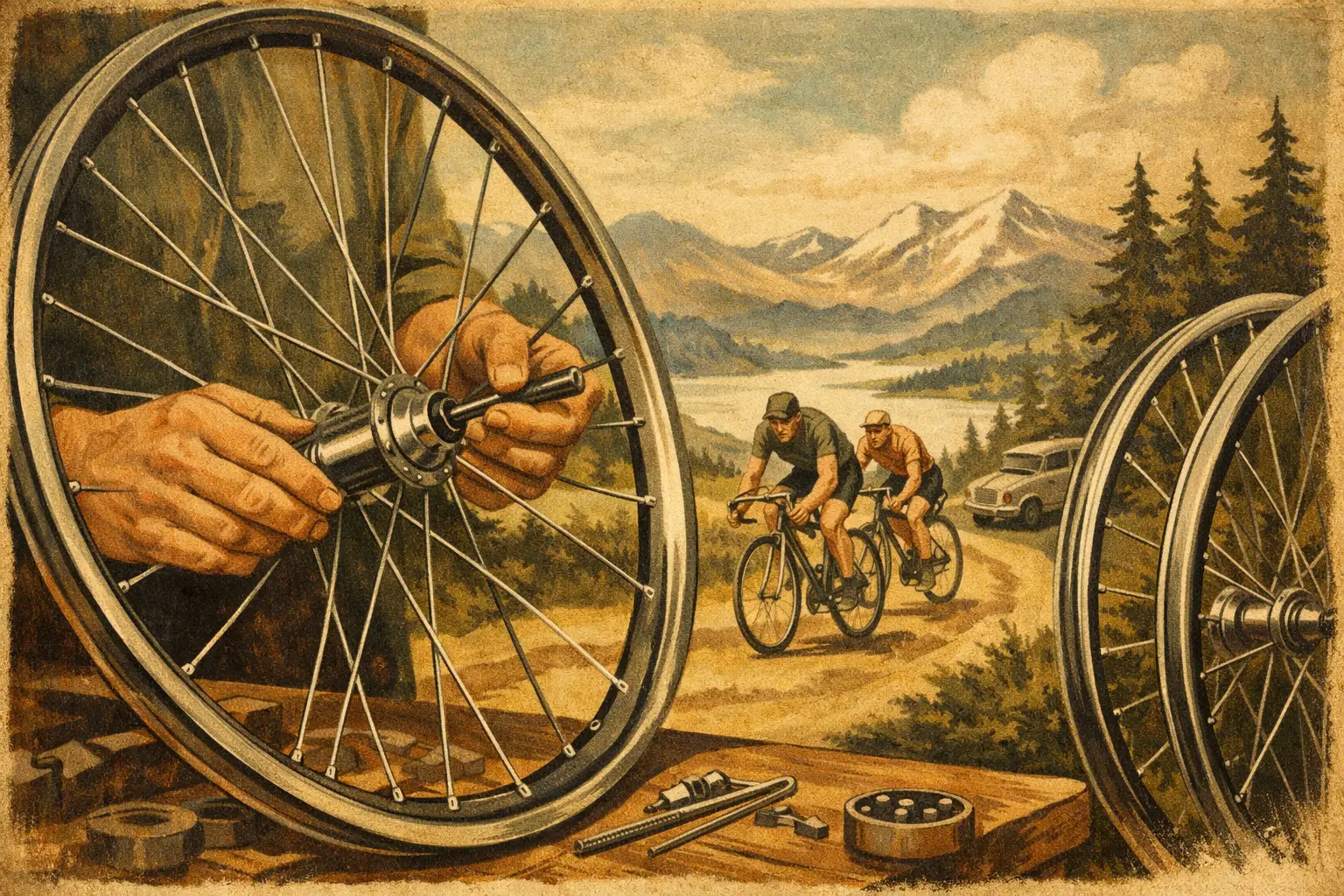
A wheel can look perfectly ordinary on the workstand yet decide whether a long ride is fast and quiet or punctuated by rubbing brakes, loose spokes and a call home. Hand built DT Swiss wheels are worthwhile because the parts can be selected, prepared and tensioned as a system around the rider, the bike and the ground actually being covered – not simply assembled to a broad catalogue specification.
For British road, gravel, touring and mountain riding, that distinction matters. Potholes, wet grit, off-camber tracks, loaded luggage and winter mileage impose repeated loads that expose a poorly matched wheel build quickly. A properly specified hand-built wheel is not about chasing a fashionable spoke pattern. It is about maintaining spoke tension, protecting the rim and hub, keeping the wheel true, and making future servicing straightforward.
Why hand built DT Swiss wheels are different
DT Swiss components have earned their place in serious wheel builds because they offer a well-developed, serviceable platform. Their hubs, spokes, nipples and rims cover a useful range from lightweight road use to hard trail and expedition work. Most importantly, replacement parts and sensible service procedures are available. That is a better long-term proposition than a proprietary system that becomes awkward to repair when a rim is damaged or a bearing finally wears out.
The hub is only one part of the wheel, however. A high-quality DT Swiss hub cannot compensate for an unsuitable rim, too few spokes, poor lacing choices or uneven tension. Equally, a tough rim will not survive indefinitely if spokes are allowed to lose tension and repeatedly unload under cornering or impacts.
Wheel building is the controlled balancing of these variables. Rim profile and internal width must suit the tyre size and intended pressure. Spoke count must reflect rider mass, luggage, power output, terrain and wheel size. Spoke gauge and butting determine how the spoke shares load and how much fatigue resistance is available. The final tension must be high enough and sufficiently even for the wheel to remain stable, without exceeding what the rim can safely tolerate.
The hub choice should follow the job
For many road, gravel and endurance builds, a DT Swiss 350 hub is a sensible starting point. It is proven, widely serviceable and available in the axle standards modern bikes require. It is not automatically the right answer for every bike. A lighter road rider may prioritise low rotating mass, while a loaded tourer or powerful e-bike may benefit more from a robust shell, appropriate flange geometry and a carefully chosen spoke count.
Engagement is often discussed as if more is always better. Faster engagement can feel positive when ratcheting through technical terrain, but it is only one characteristic. Bearing condition, freehub durability, sealing, flange spacing and the ease of obtaining service parts may have greater value over years of use. For road and gravel endurance riders, reliability normally outranks a marginal change in pick-up feel.
The engineering behind a durable wheel build
A wheel supports the rider largely through tensioned spokes. When the tyre contacts the ground, the spokes nearest the contact patch reduce tension slightly; they do not act like compression struts. If starting tension is too low, those spokes can go slack. Repeated slackening encourages nipples to unwind, allows the rim to move and increases fatigue at the spoke elbow or threaded end.
That is why a wheel should not be judged solely by whether it is initially straight. It needs even tension around the rim, correct dish relative to the frame or fork, appropriate stress relief during building, and a stable result after bedding in. Stress relieving is not a cosmetic final step. It helps settle spoke bends, crossings and interfaces so that the wheel does not lose its shape during the first demanding rides.
The rear wheel deserves particular attention. Modern cassette bodies create a significant difference between drive-side and non-drive-side spoke angles. This leads to an unavoidable tension imbalance. A good builder works within that constraint through rim selection, lacing pattern, spoke choice and careful tension control. The aim is not a number on a gauge for its own sake, but a stable wheel with adequate non-drive-side tension and a rim that remains within its limits.
Rim width, tyre volume and real conditions
A rider moving from 25 mm road tyres to 32 mm all-season tyres, or from narrow gravel rubber to 45 mm tyres, is changing more than comfort. Tyre width affects rim suitability, casing support, impact resistance and the pressure range that can be used safely. The current fashion for ever-wider rims has limits. Too wide a rim can alter tyre profile in unhelpful ways, while too narrow a rim may leave a larger tyre poorly supported at lower pressures.
For rough British lanes, a slightly more forgiving wheel and a higher-volume tyre can often be faster than an ultra-light, deep-section race setup. The reduced vibration reaching rider and bike can preserve comfort and control over long distances. On the other hand, a competitive road rider on smoother surfaces may reasonably value an aerodynamic rim profile and lower mass. The correct specification depends on the ride, not the label attached to the bike.
Tubeless compatibility also deserves a practical conversation. Tubeless can reduce punctures from small thorns and allow lower pressures, particularly on gravel and mountain bikes. It also introduces sealant maintenance, potential seating issues and mess during trailside repairs. A hand-built wheel should use a rim and tyre combination known to work sensibly together, rather than relying on optimism and an oversized blast of air.
Choosing the right spoke count and pattern
There is no universal best spoke count. A light solo road rider may be well served by 20 or 24 spokes where the rim and intended use support it. A larger rider, a rider producing high torque, someone carrying luggage, or anyone riding poor surfaces may be better served by 28, 32 or more. The small weight penalty is often insignificant beside the gains in stability, repairability and fatigue life.
Spoke type matters as much as the quantity. Double-butted spokes are often an excellent choice because their thinner central section can distribute strain more effectively and improve fatigue resistance, while retaining strength at the elbow and thread. Straight-gauge spokes can suit some heavy-duty applications, but they are not automatically stronger in a completed wheel. The quality of the build and the way load is shared are decisive.
Lacing pattern should also be functional. Radial lacing can be appropriate at a non-disc front hub where loads are modest and the hub manufacturer permits it. Crossed patterns are normally more suitable where the wheel must transmit braking or pedalling torque, particularly for disc-braked wheels, rear wheels and e-bike applications. A builder should respect hub guidance and use the pattern that supports the intended loads rather than selecting it for appearance.
Serviceability is part of performance
A wheel that can be maintained stays performing. Brass nipples add a little weight but offer worthwhile corrosion resistance for year-round riding, especially where road salt and wet grit are routine. Alloy nipples can be appropriate in a weight-conscious build, but need sound preparation and realistic expectations about long-term exposure. The same principle applies to bearings, freehub mechanisms and rim tape: a few grams saved can become false economy if routine service becomes difficult.
DT Swiss ratchet hubs are valued in part because routine internal cleaning and lubrication are comparatively straightforward. That does not mean they should be ignored until they complain. Wet winter use, frequent washing and long mileage can all carry contamination into bearings and freehub systems. Periodic inspection prevents a minor service job becoming a damaged ratchet, seized bearing or worn freehub body.
Wheel inspections should be equally routine. Check for a developing lateral wobble, a change in spoke tone, loose nipples, cracks around eyelets, damaged rim sidewalls and bearing play. Disc-brake riders can miss a small wheel deviation because there is no rim brake as an immediate warning. That makes occasional close inspection more valuable, particularly after a hard pothole strike or a loaded trip.
When a custom build makes most sense
A hand-built wheel makes particular sense when a standard wheelset does not fit the rider or the bike. That may be a gravel bike carrying bikepacking loads, a tandem or adaptive cycle, a high-mileage commuter, a converted e-bike, an older frame with unusual axle dimensions, or a performance road bike where the owner wants serviceable equipment rather than a sealed system.
At Ewhurst Bikes, the useful starting point is not a stock wheelset name. It is an honest discussion about rider weight, tyre size, route surfaces, braking system, luggage, mileage and any history of broken spokes or cracked rims. Those details reveal whether the problem is insufficient spoke count, an unsuitable rim, poor tension, an axle-standard compromise or simply a wheel that has reached the end of its working life.
If your current wheels are repeatedly drifting out of true, do not assume tightening a few spokes is the full repair. Ask why they are moving, choose components that can be serviced in years rather than seasons, and build for the rides you intend to finish.

Leave A Comment