
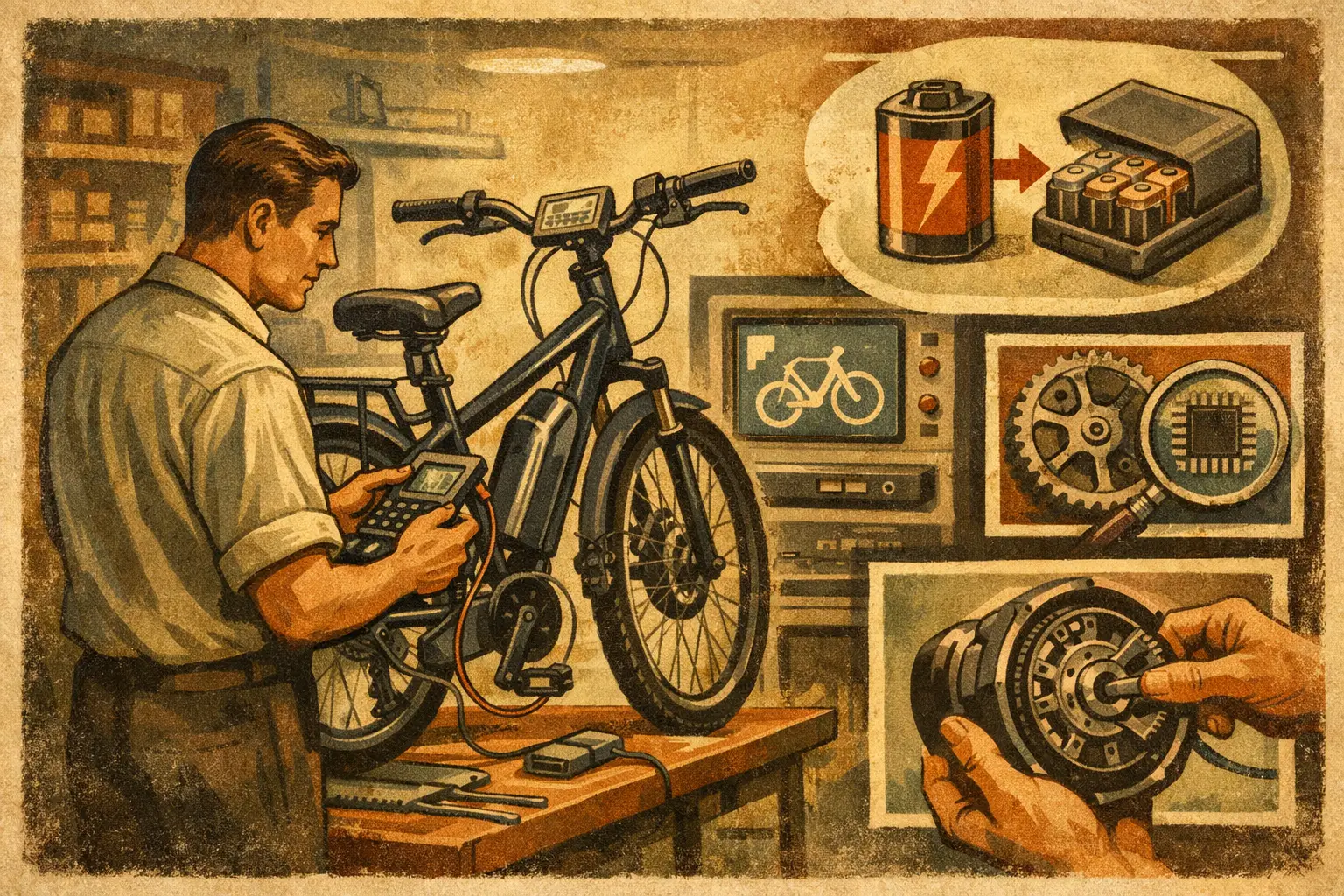
A warning light, intermittent assistance or a battery that now falls flat halfway home is not a diagnosis. An e-bike diagnostic service is the process of establishing why the system is behaving as it is, then deciding whether repair is safe, worthwhile and likely to last. For a commuter relying on their bike every day, or an endurance rider carrying a loaded machine into remote country, that distinction matters.
Replacing the part named by an error code can be expensive guesswork. The fault may lie in the battery, charger, harness, display, speed sensor, motor, firmware, a corroded connector or the mechanical load the motor is being asked to overcome. Proper diagnosis separates the symptom from the cause.
What a proper e-bike diagnostic service involves
An e-bike should be assessed as a complete machine, not simply plugged into a computer and handed back. Manufacturer software can be useful where it is available and appropriate, but it is only one source of evidence. Error histories, live sensor values and battery information need to be checked against the condition of the wiring, the drivetrain and the rider’s report of when the fault occurs.
The first part is usually a conversation. Does assistance cut out on steep climbs, after rain, under high load, at a particular battery percentage or only once the bike has warmed up? Has the bike been stored in a cold shed, carried on a rear rack in heavy weather, crashed, converted, modified or left unused for months? These details often narrow the investigation far more effectively than starting with a random replacement part.
The electrical inspection then looks for obvious and less obvious problems: damaged insulation, pulled cable entries, loose terminals, water ingress, overheated connectors, corrosion, poor previous repairs and wiring that chafes as the suspension moves or the bars turn. A connection can appear sound at rest but lose contact under vibration or load.
Battery assessment is equally important. A battery can show a reassuring percentage on the display yet sag badly when the motor demands current. Its management system may have logged a fault, or it may be protecting cells that have become unbalanced or deteriorated. Testing must be carried out with respect for the voltage, stored energy and fire risk involved. Opening, probing or attempting to rebuild lithium-ion packs without the right knowledge and equipment is not a home maintenance task.
A road test, where safe and appropriate, puts the results in context. It can reveal intermittent speed-sensor signals, torque-sensor irregularities, drivetrain drag, bearing roughness or motor noises that do not appear on a stand. The aim is not merely to make the code disappear, but to establish confidence that the bike will perform correctly when it matters.
Electrical faults are not always electrical faults
Electric assistance magnifies problems elsewhere in the bicycle. A badly worn chain and cassette, contaminated brakes, seized wheel bearings, a binding hub, tight suspension pivots or tyres run at unsuitable pressure can all increase demand on the system. The rider experiences reduced range, noise or a motor that seems weak, when the motor itself may be functioning correctly.
This is particularly relevant on cargo bikes, adaptive cycles, electric handcycles and heavily loaded touring machines. Their motors work harder, their wiring often has a longer or more complex route, and their braking and wheel loads are substantial. Diagnosis has to account for the machine’s intended use, rider weight, terrain, luggage and real-world duty cycle.
There is a trade-off here. A quick check may be enough to identify a simple damaged cable or flat battery, but it is not the same as a fault investigation on an intermittent system. If the problem occurs only after 40 minutes of climbing in wet weather, the workshop needs a clear brief and may need time to reproduce the conditions safely. That time is not wasted when it avoids fitting costly components that never needed replacing.
Battery health, range and charging concerns
Reduced range is one of the most common reasons riders seek help, but it does not automatically mean the battery is finished. Cold temperatures reduce available capacity. A heavier rider, headwind, soft off-road surface, low tyre pressure and high assistance settings will all change range dramatically. So will a drivetrain that is overdue for replacement.
Where battery condition is the underlying issue, the sensible repair route depends on the battery’s age, provenance, physical condition and compatibility with the rest of the system. A swollen, damaged, water-affected or overheating battery should be removed from service immediately and handled appropriately. A pack with diminished capacity but no safety concern may still be practical for local use, while a rider who needs dependable all-day range may be better served by a replacement solution.
The charger should be checked too. A charger that fails to reach the correct output, has a damaged lead or intermittently loses connection can mimic battery trouble. Equally, a charge port that is loose or contaminated can create heat and unreliable charging.
Motor, sensor and software faults
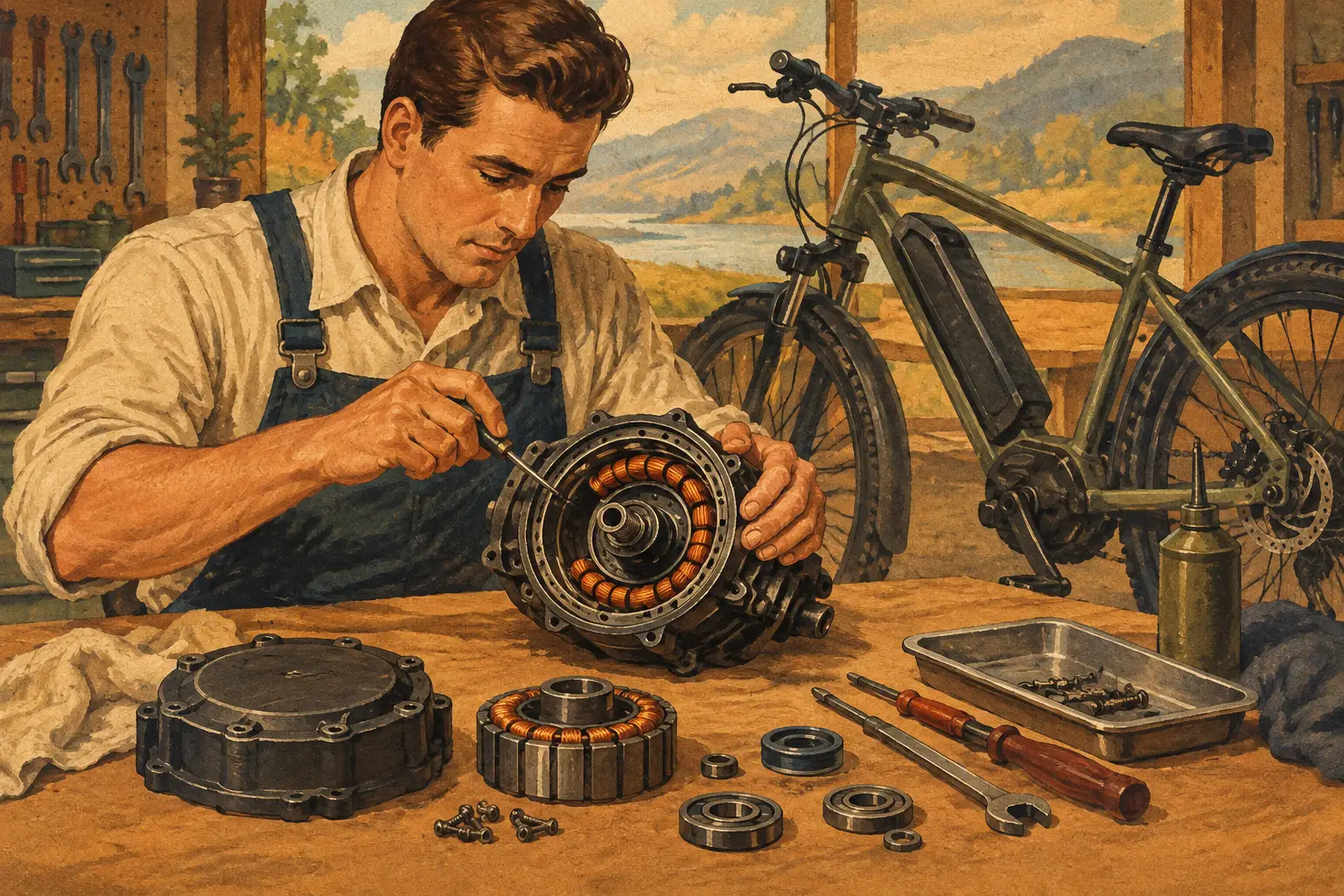
Motor faults range from straightforward external wiring issues to internal mechanical or electronic failures. Grinding, rumbling or excessive free play can indicate bearing or gear wear. Sudden cut-outs may relate to sensor signals, battery communication, firmware compatibility or protection triggered by heat or current demand.
Not every system can, or should, be repaired at component level. Some manufacturers support replacement modules only; others provide meaningful diagnostic access and parts support. Availability matters. A technically possible repair is not automatically the best value if the required parts are obsolete, unsupported or cannot be verified as safe.
Software updates can resolve known issues, but they should not be treated as a cure-all. Updating a system without first understanding the fault can complicate a warranty claim, alter settings or conceal the evidence needed to diagnose an intermittent problem. The right approach is measured: record the condition, identify the likely cause, then apply updates where they are justified.
Why conversion and refurbished e-bikes need closer inspection
A well-engineered conversion can transform a useful bicycle into a practical everyday machine. A poorly installed one can create problems at the frame, brakes, wheels, wiring and handling long before the motor itself fails. Cable routing, battery mounting, axle security, torque reaction, weather sealing and brake capacity all deserve scrutiny.
A battery mounted to a light bottle-cage interface, for example, can loosen under repeated road impacts. A powerful hub motor may place loads on a dropout that the original frame was never designed to resist. A wiring loom tied too tightly to a moving fork can fail internally after thousands of steering cycles. These are engineering problems, not cosmetic details.
Refurbished e-bikes deserve the same discipline. The attractive price of an older machine can be offset by a battery with limited remaining life, unavailable electronics or evidence of water ingress. Before spending money on upgrades, establish whether the core system is safe, supportable and suitable for how you intend to ride it.
What to bring to an e-bike diagnostic appointment
Bring the bike, its battery, charger, display or key where applicable, and any error-code information. If you have service records, proof of purchase, conversion details or photographs of a previous fault, bring those too. Do not deliberately run a suspect battery flat or continue riding a bike that is overheating, smelling unusual, producing smoke or showing visible battery damage.
Be ready to describe the fault precisely. “It stopped working” is a starting point, but “assistance cuts out after ten minutes on maximum mode, then returns after a restart” gives a technician something testable. Mention any recent crash, jet washing, transport on a rack, storage in freezing conditions, component changes or attempts to repair the wiring.
A good workshop should explain the findings in plain terms and obtain approval before major work proceeds. You should understand what has failed, why it may have failed, what repair options exist and what compromise each option brings. Sometimes the answer is a modest wiring repair and a service. Sometimes it is a battery replacement. Occasionally, the honest answer is that further spending will not create a reliable machine.
Choose diagnosis that protects the whole bike
Electric bikes are serious, high-energy machines, and the quality of the diagnosis affects more than convenience. It affects braking, handling, range, fire safety and whether you trust the bike on a dark commute or a long ride far from home. At Ewhurst Bikes, the aim is to trace faults to their root cause, assess the mechanical and structural condition around them, and agree a repair path that makes practical sense.
If your e-bike is giving mixed signals, stop guessing at parts. Record what it does, bring the complete system to an appointment, and let the evidence decide the next repair.







Leave A Comment