
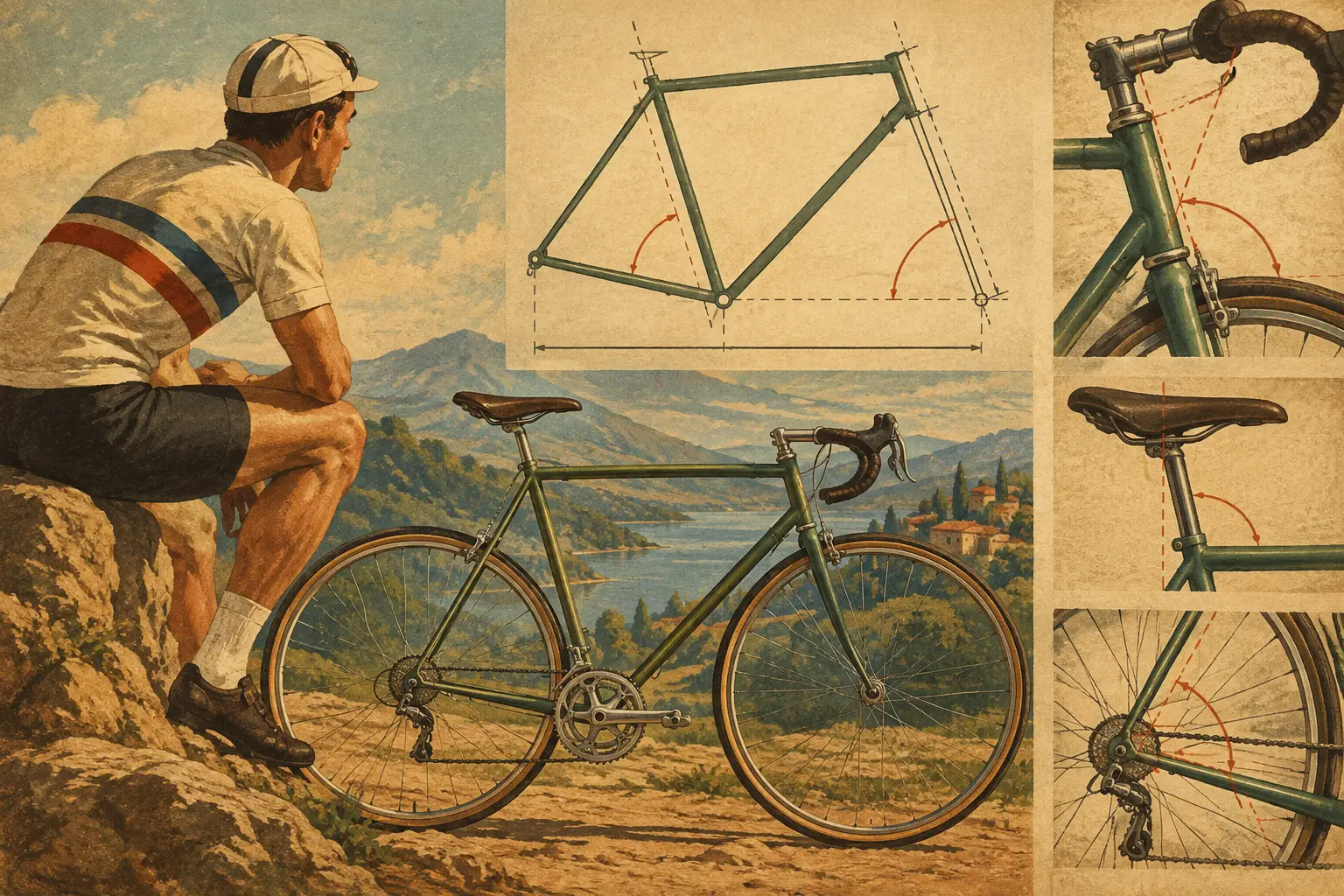
A frame can be made to your dimensions and still be wrong for the work you expect it to do. That is the point of a proper custom bicycle geometry guide: not to chase unusual numbers, but to engineer a bicycle around your body, riding position, terrain, equipment and intended mileage. A fast Sunday road bike, a rough-gravel endurance machine and a loaded touring bike may suit the same rider, yet require markedly different geometry.
Custom geometry is most valuable when standard sizing forces a compromise. Perhaps you need a high handlebar without a tower of spacers, have unusually long legs relative to your torso, require clearance for wide tyres and mudguards, or want predictable handling after 12 hours in poor weather. The frame is the structural foundation for all of it.
Start with the rider, not the frame size
Traditional seat-tube sizes are a poor shorthand for fit. Two frames labelled 56 cm can place the saddle, bars and wheels in very different positions. For a bespoke project, the useful starting points are stack, reach, saddle position, handlebar position, crank length, foot clearance and the rider’s actual movement on the bike.
Stack is the vertical distance from the bottom bracket to the top of the head tube. Reach is the horizontal distance between those points. Together, they describe the front-end space far more accurately than a nominal frame size. They help establish whether a rider can maintain a sustainable position without excessive stem length, spacer height or a radically angled stem.
That does not mean every endurance rider needs an upright front end. Some riders are flexible, experienced and efficient in a lower position, while others lose power or develop hand, neck or lower-back discomfort if asked to hold it for long. The right position is one you can sustain while breathing freely, steering accurately and producing useful power – not one that merely photographs well.
Saddle position must be considered separately from reach. Moving a saddle backwards changes both pedalling mechanics and the weight carried by the front wheel. If a rider has compensated for an unsuitable frame by using extreme saddle setback, a very long stem or a short stem with wide bars, the geometry needs investigating before copying those settings into a new build.
Measure the working position
A sound assessment looks beyond inseam and height. Useful information includes current bicycle measurements, preferred saddle model, shoe and pedal system, flexibility, previous injuries, riding history and where discomfort begins. A rider who is comfortable for two hours but not for ten needs a different answer from one who races for an hour on smooth roads.
It is also worth observing the bike under load. A saddle that appears level in the workshop may be pitched down to relieve pressure on a long event. A rider may shift forwards on steep climbs or sit behind the saddle on rough descents. These habits affect the balance and control requirements of the complete machine.
Custom bicycle geometry guide: fit and handling are connected
Geometry is not only about placing the contact points. It determines how the bicycle responds when the rider turns, brakes, climbs, rides no-handed, carries luggage or meets a rutted descent at speed.
The key steering relationship comes from head angle, fork offset and wheel size. Together they create trail, which strongly influences self-centring steering behaviour. More trail generally gives a calmer, more planted feel; less trail can make steering feel lighter and quicker. Neither is automatically better.
A race-oriented road bike can use relatively responsive steering because it expects smooth tarmac, narrow tyres and an attentive rider. An all-day gravel or expedition bike often benefits from greater stability, particularly with a bar bag, frame bag or larger tyres. But excessive trail can make a bicycle feel reluctant at low speed, especially with a heavily loaded front end. The correct solution depends on how, where and how quickly the bicycle will be ridden.
Wheelbase and front-centre matter too. A longer wheelbase can improve composure over broken surfaces and reduce the chance of toe overlap with the front wheel. It may also provide useful room for mudguards and bags. The trade-off is that a long bicycle is not automatically more comfortable, and an unnecessarily stretched wheelbase can make tight, technical riding feel cumbersome.
Chainstay length is another decision with consequences. Short stays can create a lively, direct-feeling rear end and keep the bike compact. Longer stays can improve tyre clearance, heel clearance for panniers, climbing traction and loaded stability. On a custom frame, it is often possible to make a deliberate choice instead of accepting the compromise dictated by a mould, catalogue size or fashion-led silhouette.
Build around the intended tyres and equipment
Tyre clearance should be specified in real terms, not optimistic marketing terms. A nominal 45 mm gravel tyre can measure wider or narrower depending on rim internal width, casing construction and pressure. British lanes and trails add mud, grit and wet leaf debris to the equation. Clearance that looks generous in a clean workshop can become inadequate quickly.
The same applies to mudguards. A bicycle intended for year-round riding should be designed with enough space for full-length guards, their stays and the accumulated debris encountered on winter roads. Adding them as an afterthought commonly leads to rattles, poor clearance and compromised tyre choice.
Specify the complete equipment plan early: wheel size, tyre width, mudguards, rack or luggage arrangement, bottle positions, dynamo lighting, frame bags, dropper post if relevant, and even the size of the rider’s shoes. These are not accessories in an engineering sense. They affect clearances, loads, steering and the placement of frame tubes.
A bespoke endurance frame should also account for the structural loads created by the intended use. Long-reach seatposts, large saddle bags, loaded racks and off-road riding all alter how a frame is stressed. Tube selection, junction design and reinforcement should support the geometry rather than be treated as a separate cosmetic exercise.
Do not confuse stiffness with ride quality
A custom bicycle does not need to be flexible to be comfortable, nor brutally stiff to be efficient. Ride quality comes from the entire system: tyre volume and pressure, wheel build, saddle, bar tape, rider position, frame material and the way the structure deflects under real loads.
For most endurance riders, tyres and wheels provide the largest practical gains in comfort and control. Geometry then allows the rider to use the appropriate tyre size without creating undesirable handling or clearance problems. A well-built wheel with suitable spoke tension and rim choice is as relevant to confidence on rough roads as the frame drawing.
Frame material has a role, but material alone does not dictate how a bike rides. Steel, titanium, aluminium and carbon can all be made badly or well. Tube dimensions, wall thickness, fibre orientation in composites, joint design and manufacturing quality matter greatly. For repairable, long-service machines, access for inspection, sensible cable routing and durable standards deserve at least as much attention as a claimed weight saving.
Use numbers, but test the assumptions
A geometry drawing can look precise to the millimetre while resting on weak assumptions. Rider position changes with saddle choice, cleat position, footwear and bar shape. Tyres alter the effective axle height. A different fork changes axle-to-crown length and steering behaviour. Even changing from a compact road handlebar to a flared gravel bar can alter practical reach and wrist position.
For that reason, custom design should be an iterative process. Establish the intended position, test it where possible against an existing bicycle or fit rig, then develop geometry around the chosen wheel, fork and tyre package. Review the drawing as a complete system rather than approving isolated figures.
Be wary of copying the geometry of a favourite bike without asking why it works. It may fit because of its bar height, wheel and tyre choice rather than its head angle. It may feel excellent unloaded but become nervous with camping kit. It may also mask a poor fit that you have simply adapted to over time.
When bespoke geometry is worth the investment
A stock frame remains the sensible answer for many riders. If a production bike gives you the required contact-point position, tyre clearance, handling and equipment capacity, there is no engineering virtue in making something different merely for the sake of it.
Bespoke geometry earns its place where the standard market cannot meet the requirement cleanly: demanding endurance events, unusual proportions, adaptive applications, injury-led fit constraints, specialist luggage needs, large tyre and mudguard combinations, or a single bicycle expected to perform reliably for years. It is also valuable when a frame must be designed alongside structural features, modifications or future serviceability from the outset.
At Ewhurst Bikes, custom frame and fork projects begin with the actual job the bicycle must perform, not a fashionable set of angles. The aim is a machine that places you correctly, behaves predictably and has the durability to justify its place in the workshop and on the road.
The most useful geometry is rarely the most extreme. It is the geometry that disappears beneath you on a wet, tired final hour, leaving you free to concentrate on the road ahead rather than compensate for the bicycle.






Leave A Comment